

The Last Thing Netflix Called Uncorked Scored 94% with Critics and Moved No Wine at All
A Korean importer sold 50 cases in two days because of a comic book. That is the bar prestige television keeps failing to clear.

Welcome to issue #012 of The Decant. Each week, I help you make sense of Netflix’s Uncorked and the wine world it’s about to land in. No trade subscription required.
You have ordered a Pinot Noir at some point because it felt like the more considered choice, and somewhere behind that feeling is a movie you watched twenty years ago. You have never once ordered a bottle because of a prestige dramedy, no matter how good it was.
That gap is the most interesting unsolved problem in wine media, and Netflix is about to walk straight into it. In March the company gave a straight-to-series order to a Napa Valley romantic comedy from Darren Star and David Schulner. Rick Porter reported the logline in the Hollywood Reporter: a talented, self-destructive winemaker returns to Napa chasing love, legacy, and, in the show’s own words, “that elusive 100 point wine.” Star is still running Emily in Paris. The title is Uncorked.
Which is where the first problem starts, because Netflix has used that title before.
The last thing Netflix called Uncorked
In 2020 Netflix released a film called Uncorked, written and directed by Prentice Penny, about a young man named Elijah who works in his family’s Memphis barbecue restaurant and wants to sit the Master Sommelier exam while his father waits for him to take over the business. Mamoudou Athie played Elijah, Courtney B. Vance his father, Niecy Nash his mother.
It was good. Rotten Tomatoes has it at 94 percent from 48 critics. It takes blind tasting seriously as a craft with real stakes, and it makes a Black family’s expectations the actual dramatic engine, which almost no wine film has ever bothered to do.
Its world premiere was set for South by Southwest on March 14, 2020. Netflix pulled its films from the festival on March 4, Austin cancelled the whole event on March 6, and the film went out on the platform on March 27, into the first weeks of global lockdown. The audience score sits at 63 percent.
Almost nobody remembers it. Nothing measurable happened to how anyone drank.
The Emmy that moved nothing
The strongest possible test of whether excellence moves wine culture already ran, and it ran recently.
Drops of God premiered on Apple TV+ on April 21, 2023, created by Quoc Dang Tran and directed by Oded Ruskin, with Fleur Geffrier and Tomohisa Yamashita as estranged heirs competing over the greatest wine collection in the world. It won Best Drama Series at the International Emmy Awards in November 2024. Rotten Tomatoes has the first season at 100 percent and the second at 92.
By every measure the industry uses to declare something important, it worked. And nothing measurable followed it into a wine shop. No varietal shows a break in the retail data, no wine list got rewritten around it, and the only documented effect on a named producer is the one I get to below, which amounts to a handful of inquiries.
I want to be careful here, because calling an Emmy winner a failure would be both wrong and lazy. The series is excellent and it did what a television series is built to do. It simply never reached the shelf.
The comic book cleared the bar the series could not
Here is the part that turns this from an anecdote into a controlled experiment: the same story, in a different format, produced documented sales jumps for the specific wines it named.
Drops of God began as Kami no Shizuku, a manga by the siblings writing as Tadashi Agi with art by Shu Okimoto, serialized from 2004. Sophie Hardach reported the consequences for the Globe and Mail in June 2007. A Korean importer sold 50 cases of Château Mont-Pérat, an unremarkable Bordeaux, in two days after the manga named it. Umberto Cosmo said sales of his Colli di Conegliano Rosso jumped about 30 percent. Hardach noted that the manga deliberately featured wines in the nine to seventeen dollar range alongside the trophies.
It kept happening for years. Luke Tsai reported for KQED in September 2023 that after the manga featured Broc Cellars, a small Berkeley winery, general manager Bridget Leary put it plainly: “our audience doubled.”
Tsai also reported the control condition, in the same piece. Tegan Passalacqua’s Sandlands Mataro appeared in the Apple TV+ series. He got inquiries, and the wine had already sold out.
Same intellectual property. Same wines, in some cases. One format sold cases of the wines it named and the other generated inquiries about a wine that was already sold out.
The one case anyone has actually measured
Which brings us to the only screen event in wine whose effect on drinking behavior anyone has measured with real data and published.
Sideways opened on October 22, 2004. It was not a phenomenon by box office standards. Steven Cuellar and his co-authors note in their paper that the film grossed just over $70 million domestically and a little past $100 million worldwide across thirty weeks in theaters, making it the fortieth highest-grossing film of the year. The number one film that year, Shrek 2, took over $440 million domestically. Sideways collected five Academy Award nominations and won one.
Cuellar, an economist at Sonoma State, worked with Dan Karnowsky and Frederick Acosta on annual retail scan data covering 1999 through 2008, using Cabernet Sauvignon and Syrah as a control group for wines the film never mentions, and testing for a statistical break in each varietal’s growth rate after 2005. The paper went out through the American Association of Wine Economists in October 2008 and was published in the Journal of Wine Economics in 2009.
The care in the design is what makes the result worth anything. A varietal can rise in a given year because a chain put it on an endcap, or ran a mailer, or knocked a dollar off, so the authors separated promoted from non-promoted sales throughout and reported both. Their promotion categories were features such as mailers and newspaper ads, in-store displays, combinations of the two, and temporary price reductions of five percent or more. The Sideways result holds in both the promoted and the non-promoted data.
What they found is more interesting than the folklore. All three groups showed a statistically significant break, so something happened to the whole red category. Against the control, Pinot Noir’s case volume growth rose sharply and Merlot’s fell. Merlot’s real price declined while Pinot Noir’s rose. Segmented by price, Merlot’s losses concentrated in bottles under ten dollars, while Pinot Noir gained across all three price bands, with the effect generally growing as the price point went up.
So the version you have heard, where a single line of dialogue destroyed Merlot, is too strong. The measured decline is small, statistically real, and concentrated at the cheap end. The Pinot Noir gain is the large, unambiguous half of the result.
The long tail is where it stops being subtle. Kathleen Willcox reported for InsideHook in December 2024, using Santa Barbara Vintners figures, that Santa Barbara County had 1,154 acres of Merlot planted in 2002 and 152 acres in 2024. The county went from around 60 wineries in 2001 to more than 300.
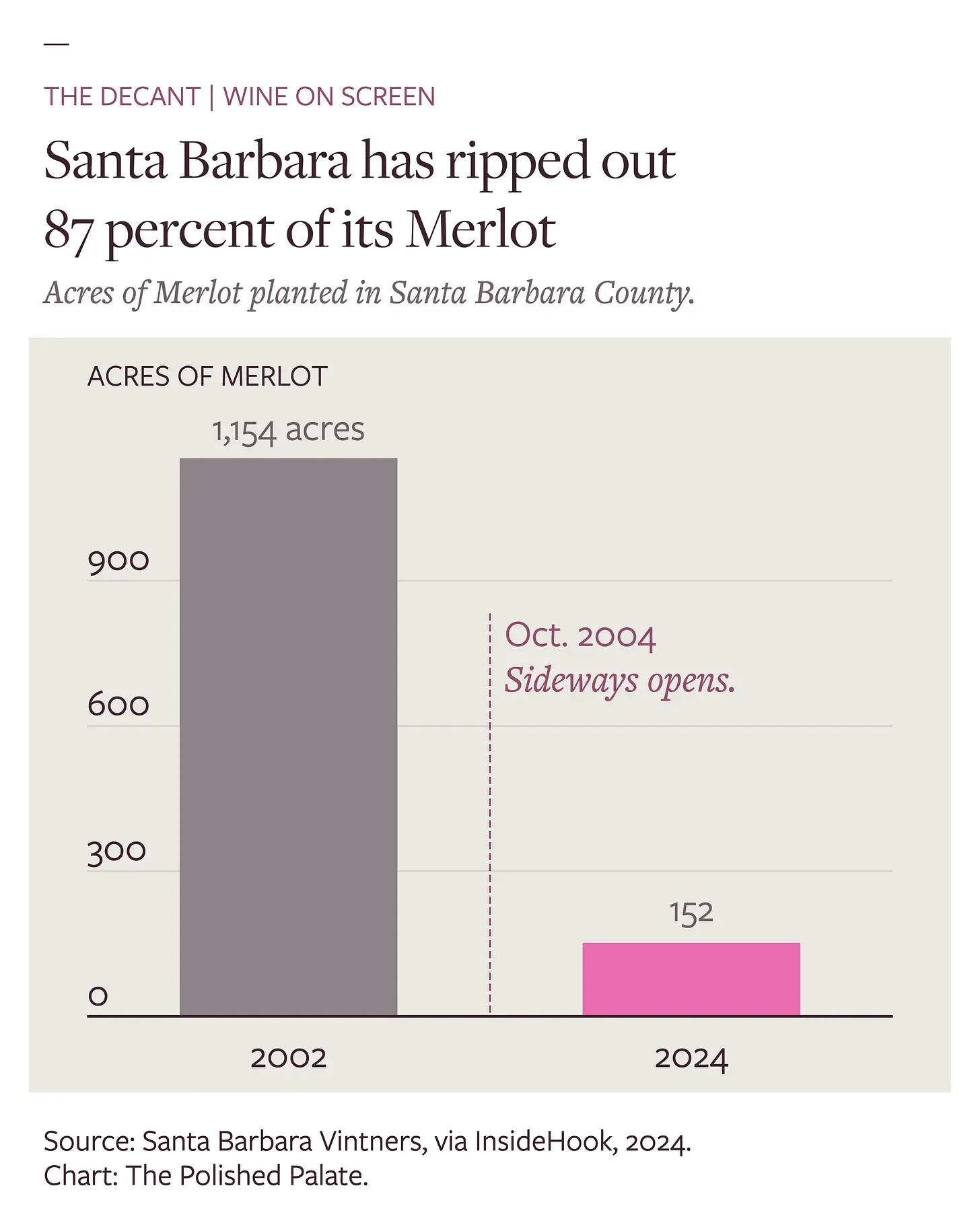
The money followed the plantings. Willcox reports the county’s wine grape crop was worth about $65.8 million across 16,667 acres in 2003, and roughly $98.6 million across 11,168 acres in 2023. Fewer acres, more money, because the price per ton rose 67 percent, from $1,371 to $2,292. A film that finished fortieth for the year rearranged which vines were worth planting in an entire county, and then made the survivors more valuable.
Sideways gave people something to do
Audience size turns out to be a poor predictor. Sideways finished fortieth for the year and reorganized a county’s plantings. Drops of God won the International Emmy and reorganized nothing.
The difference is that Sideways handed the viewer a line to say out loud, in a restaurant, in front of other people, and the line did social work. Refusing Merlot was cheap to perform, instantly legible to everyone at the table, and it made you look like someone with a position. The manga did the same job through a different door: it named a specific bottle at a specific price and told you where the pleasure was, which is a shopping list.
Prestige television lets you watch someone else be the expert. It gives you nothing to say or order the next time you are out to dinner.
There is a second thing Sideways had, and it is geographic. The film gave people a place to go. Santa Barbara County was drivable from Los Angeles, the wineries were open, and the tasting rooms multiplied fivefold in two decades. Drops of God is set across Tokyo and Paris, and its central object is a private cellar of 87,000 bottles that no viewer will ever stand in. A person who finishes the season and wants to participate has nowhere to drive and nothing to buy.
Pocket Palate: what actually moves a wine market
Five things the record shows about wine on screen.
Acclaim buys nothing at the shelf: Drops of God holds 100 percent on Rotten Tomatoes for season one plus an International Emmy, with no measurable effect on what Americans drink.
Audience size buys little either: Sideways finished fortieth at the 2004 box office and still shows up in retail scan data as a structural break.
A sayable line buys behavior: the film handed viewers something to perform in front of other people, at no cost and with instant social meaning.
A named bottle at a named price buys sales: the Drops of God manga moved 50 cases of Château Mont-Pérat in two days and lifted one Italian producer’s sales about 30 percent.
The effect feels like your own taste: a whole generation avoids Merlot without knowing the preference came from a movie.
The Finish
So which one is the new Uncorked going to be?
The honest answer is that the ingredients point in a direction. A romantic comedy about a winemaker chasing a perfect score, from the creator of Emily in Paris, is built to produce a place people want to visit and a phrase people want to repeat, which is the Sideways shape whatever the show’s quality turns out to be.
Star has already run this play once at scale. The Irish Times reported in April 2026, citing a 2024 study by France’s national film centre, that 80 percent of visitors surveyed in Paris had been inspired to come by a film or series shot there, that one in ten named a screen production as their main reason for the trip, and that Emily in Paris was by far the most cited title. Whatever you think of that show, it demonstrably moved human beings across an ocean.
So if Uncorked lands, expect Napa visitor numbers to move, expect one specific style of Cabernet to get harder to find, and expect a lot of people to start using the number 100 as though it means something. I wrote in June about what that number actually costs the people growing the fruit.
Here is the part worth sitting with. Every one of these effects works by handing you a preference and letting you experience it as taste. Miles refuses Merlot, and twenty years later a whole generation still avoids the grape without ever asking where the dislike came from.
This week, pour a good Merlot. Not a supermarket bottle, a real one: a Saint-Émilion, a Ridge Estate Merlot, or a Pomerol if the budget allows. Drink it without deciding in advance what you think. Then ask yourself where the opinion you have been carrying about that grape actually came from, and whether you have ever tested it.
A pairing for reading this one: the Merlot you would not have ordered in 2005.
Go Deeper
If this week’s idea stuck with you, these take it further.
Kathleen Willcox, How “Sideways” Transformed a Grape and a Town (InsideHook, 2024): The twenty-year accounting, with Santa Barbara County acreage and winery counts and Rex Pickett on what he set in motion.
Luke Tsai, How a Beloved Manga Helped a Berkeley Winery Blow Up in Japan (KQED, 2023): The Broc Cellars story, and the quieter contrast with what the Apple TV+ adaptation did for the wines it featured.
Sophie Hardach, Japanese comic boosts wine sales (The Globe and Mail, 2007): Contemporary reporting from the peak of the manga’s influence, including the Mont-Pérat and Colli di Conegliano numbers.
Steven Cuellar, Dan Karnowsky and Frederick Acosta, The Sideways Effect: A Test for Changes in the Demand for Merlot and Pinot Noir Wines (American Association of Wine Economists, 2008): The working paper behind the Journal of Wine Economics article, with the scan data, the control group, and the price-segment breakdown.