

The 100-Point Score, Explained By Someone Who Stopped Trusting It
The scale promised objectivity. The economics and the science tell a stranger story.

Welcome to issue #003 of The Decant. Each week, I help you make sense of Netflix’s Uncorked and the wine world it’s about to land in. No trade subscription required.
In 1978, a Maryland lawyer named Robert M. Parker Jr. started a subscription newsletter called The Wine Advocate and rated the wines inside it on a 100-point scale he adapted from the American school report card.
The idea was almost aggressively simple. Wine writing at the time ran on vague prose and insider stars, and a buyer could not easily tell whether a critic’s “charming” was better or worse than another critic’s “serious.” A number cut through that. Ninety beats eighty-nine. Everyone who ever got a grade in school understood it instantly.
It worked.
Within a decade the 100-point score reorganized the entire wine market, and it has run it ever since. Wine Spectator built its own version, scoring wines blind in flights, and the two scales together became the language retailers, restaurants, importers, and collectors all speak.
Walk into any wine shop today and the little cards on the shelf are quoting Parker, Spectator, or one of their successors. The number does the selling.
Here is the part the number does not advertise about itself. A wine’s quality is continuous, a smooth spectrum from thin to profound. The 100-point scale chops that spectrum into bands, and the market has decided that one of the band boundaries is a cliff - the number 90.
The same bottle scored 89 and 90 can live two completely different commercial lives, and the three or so points that carry a wine across that line do more to its price than almost anything in the bottle itself. That is the real subject of this piece: what a small change in a score actually buys, and who keeps the change.
I should say plainly where I stand. I’m a certified sommelier, I’ve sold wine off scores and bought wine off scores, and I no longer let a number tell me whether I’m allowed to like something. By the end of this you’ll understand why. Every date, figure, and study below is sourced. Where the trade record is thin, I’ll say so.
Where the number comes from
Parker’s system starts every wine at 50 points. A bottle cannot score lower than that, which means the working range most drinkers ever see runs from the high seventies to 100, and the rest is largely theoretical. From that 50-point floor, his published method adds up to 5 points for color and appearance, up to 15 for aroma and bouquet, up to 20 for flavor and finish, and up to 10 for overall quality and aging potential. Add the maximums to the floor and you reach 100.
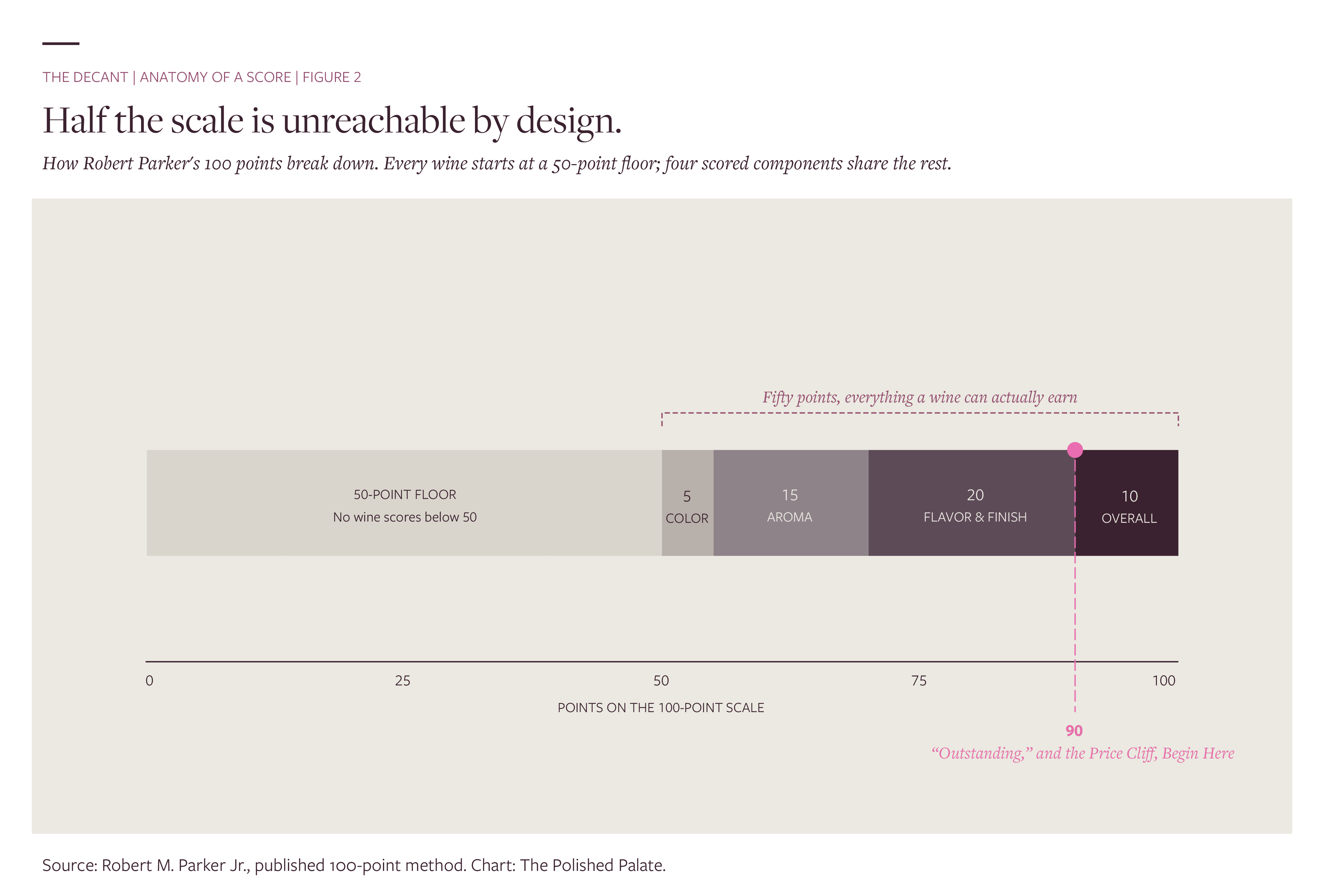
The bands sit on top of that math. In Parker’s scheme, 96 to 100 is extraordinary, 90 to 95 is outstanding, 80 to 89 is good to very good, and below 80 falls away fast. Wine Spectator’s bands run slightly differently, with 95 to 100 classic, 90 to 94 outstanding, and 85 to 89 very good, all scored blind so the taster does not know the producer or the price.
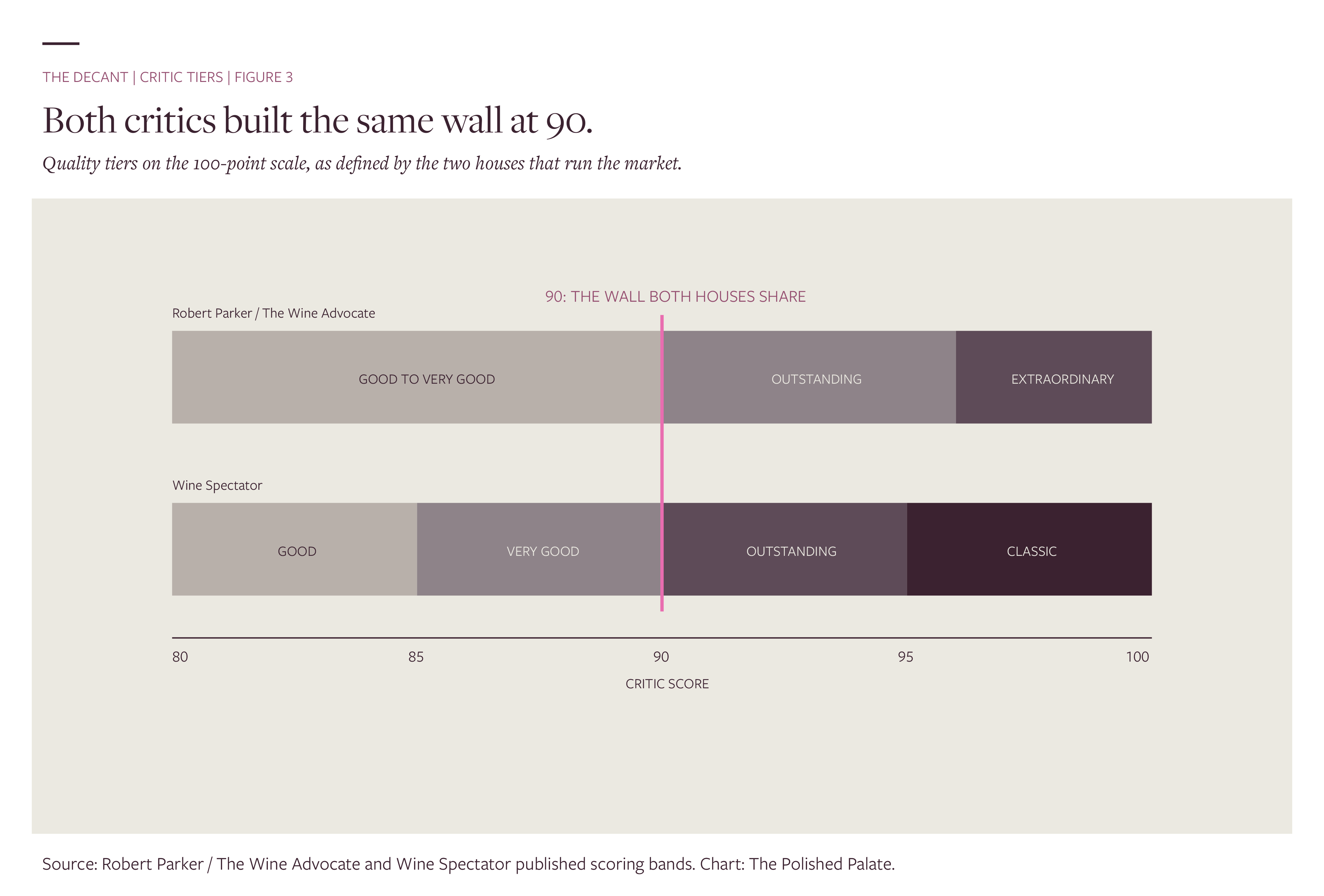
Notice what the 50-point floor does. It compresses every wine you would actually consider buying into the top half of a scale that looks like it has 100 rungs but really has about 25 that matter. An 86 and a 91 are five points apart on paper and a hair apart in the glass. The scale’s precision is mostly an illusion of its own design, a report-card format stretched over a much narrower band of real difference.
The cliff at 90
The economics are where this stops being a style argument and starts being your money. When researchers run the prices of large numbers of wines against their scores, the relationship is not a smooth upward line. For most of the scale it barely moves at all.
Hedonic analysis published in the wine-economics literature finds that the price premium attached to a higher score becomes statistically significant only for wines above 90 points, while the prices of wines scored between 50 and 90 are not reliably different from one another.
The market treats almost everything below 90 as roughly interchangeable, then pays sharply more the moment a wine clears the line.
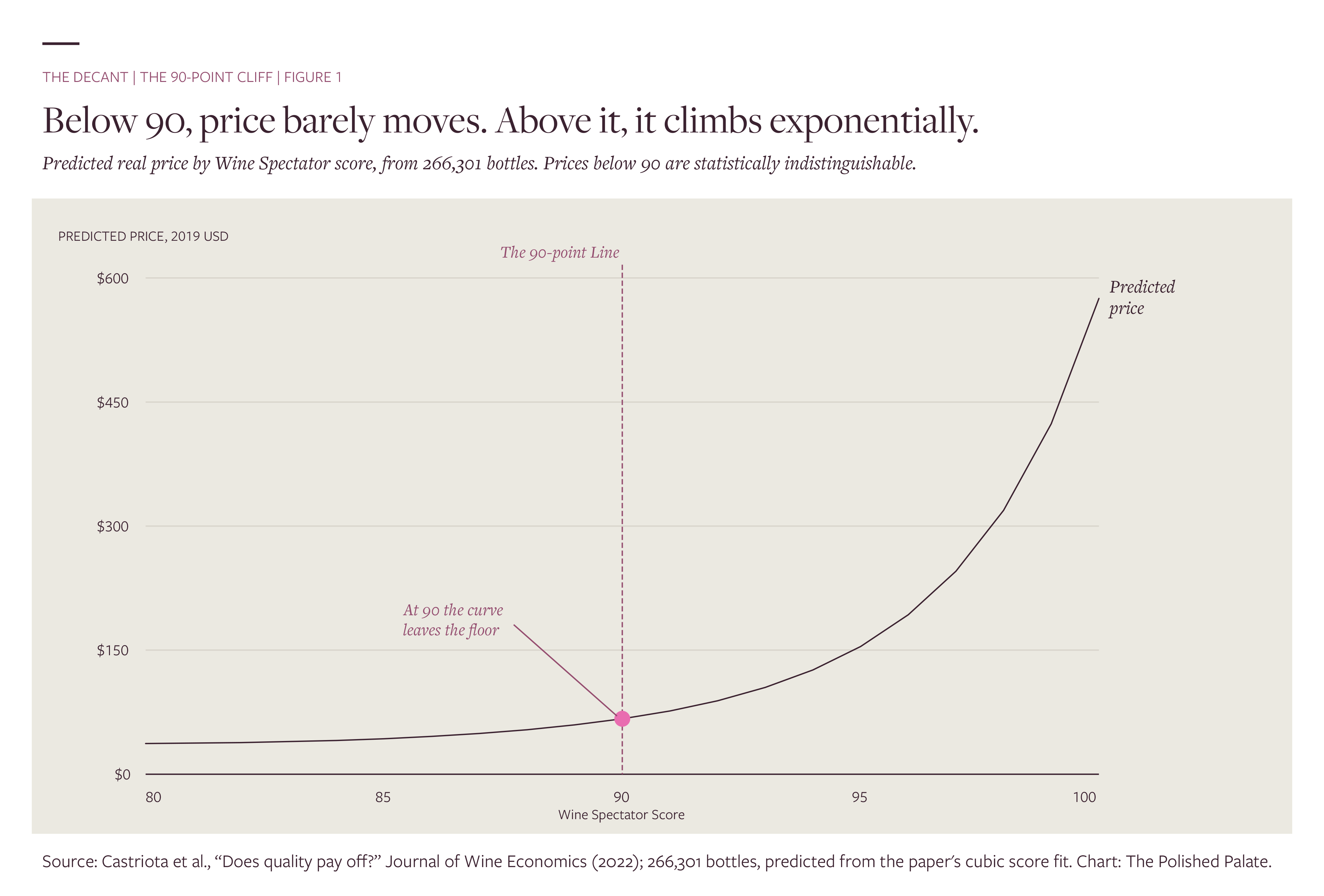
That is what a cliff means. Three points that move a wine from 87 to 90 change its commercial life, because 90 is the number distributors reorder on, shops print on the shelf card, and restaurant buyers filter their lists by. Three points that move a wine from 84 to 87, or from 92 to 95, do far less, because they stay inside a band the market has already priced as a block. The points only pay when they cross a wall.
At the everyday tier this is the difference between a bottle that sells through and a nearly identical bottle that gets marked down to move. At the top, the nonlinearity gets violent.
A few points from a trusted critic on a scarce Napa or Bordeaux wine can move release prices and secondary-market prices by hundreds of dollars, because at that altitude the score is feeding allocation lists and collectors, not dinner.
Elin McCoy’s biography of Parker, The Emperor of Wine, documents case after case of a single Parker score reordering a wine’s price overnight. Three points rarely turn one literal bottle from $40 into $400. What three points do is decide which side of a wall a wine lands on, and the wine world has built its walls exactly where the bands break.
The judges can’t always reproduce themselves
If the scale rewards precision, you would hope the precision was real. The most careful test of that came from Robert Hodgson, a California winemaker and retired oceanographer who got the organizers of the California State Fair wine competition to let him run an experiment from 2005 to 2008. Judges received flights of 30 wines, and hidden inside each flight were three pours from the very same bottle. The judges did not know.
The results are sobering.
Only about 10 percent of the judges could replicate their own score on the identical wine closely enough to keep it within a single medal group. Another group of judges occasionally scored the same wine anywhere from bronze to gold across the three pours.
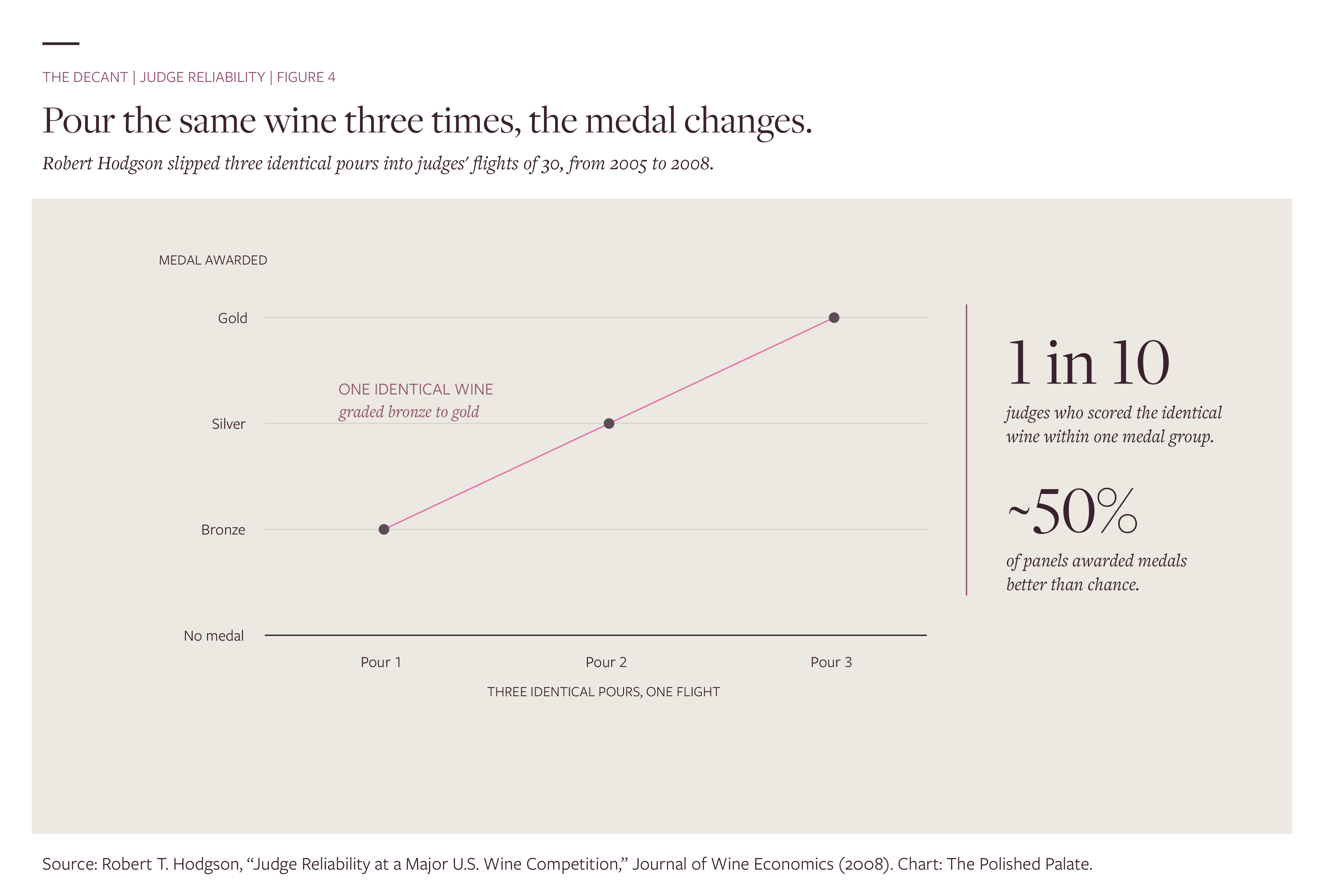
Hodgson found judges were more consistent about what they disliked than what they loved, and that across the full run of panels, only about half were awarding medals on wine quality in a way that beat chance. He later analyzed thousands of wines entered across many U.S. competitions and found that a wine winning a gold medal at one event very often won nothing at all at another.
The lesson sits one level down in resolution. Hodgson’s judges were seasoned professionals, and the identical wine still slid between medals in their hands. Human tasting, even expert human tasting, simply does not have the fineness to justify the difference between an 88 and a 91 as a stable fact about the wine. Those numbers sit inside the noise of the measurement. The scale reports to the single point while the senses underneath it work in much rougher bands.
Why the number still runs the market
So a system with an illusory precision, resting on judgments its own judges struggle to repeat, sells more wine than any other tool in the trade. That is not a paradox once you see what the number is for. Accuracy to the single point was never the goal. The number’s job was to reduce a buyer’s risk and to do it in the time it takes to read one shelf card.
Standing in a shop, unsure, a little anxious about spending $30 on something you cannot taste first, a 92 is a handrail. It transfers the decision to someone who tastes for a living, and it asks nothing of you. Parker’s real achievement in 1978 was democratic. He took a verdict that used to live with a handful of gatekeepers and merchants and handed it to anyone who could read a number, and that genuinely opened wine up. I won’t pretend otherwise.
The cost arrived with the convenience. A generation of drinkers learned to check the score before trusting the glass, to feel reassured by a 93 and faintly embarrassed to enjoy an 87. The handrail became a substitute for walking. The number tells you what a stranger thought of a wine on one morning, blind, in a flight of forty. It cannot tell you whether the oak will be too much for you, whether you want the riper bottle or the leaner one, or whether this is the wine for the table you’re actually setting tonight.
The most important variable in the room, your own taste, is the one input the scale was designed to skip. That’s the whole argument behind trusting your own palate, and it’s why the cult Napa bottles I traced in the seven-wine history of the valley command what they do.
The Finish
The 100-point score is a starting point someone else wrote down. Used as data, it’s useful: a fast read on whether a wine is sound and roughly where it sits. Used as a verdict, it quietly hands away the one decision wine is supposed to give you, which is finding out what you like.
When Netflix’s Uncorked arrives and sends a wave of new drinkers toward Napa’s most famous bottles, the scores will be doing the selling, and most of those buyers will never know the line between an 89 and a 90 is a wall the market built. You now do.
Here’s the reflective question. When did you last skip a wine because it “only” got 88, or buy one mostly because the card said 93? Sit with which of those happened more often. Then try this: on your next bottle, ignore the shelf score entirely, predict the style yourself from the grape, the region, and what the back label tells you, taste it, and only then look up what the critics gave it. Notice who was closer to your own experience. That single habit, practiced a few dozen times, is how a score stops being your boss and goes back to being a tool.
Pour while you read: something you chose without checking a score. A grower Champagne or a Loire Chenin from a producer who doesn’t chase reviews does the job nicely.
Go Deeper
The sources behind this piece, all free to read.
Robert T. Hodgson, “An Examination of Judge Reliability at a Major U.S. Wine Competition,” Journal of Wine Economics (2008) The original triplicate-pour study showing how rarely expert judges reproduce their own scores.
“Does quality pay off? ‘Superstar’ wines and the uncertain price premium across quality grades,” AAWE / AgEcon working paper. The hedonic analysis behind the 90-point cliff: a measurable premium appears only above 90, not below.
Gianni De Nicolò, “Wine Ratings and Commercial Reality,” Journal of Wine Economics (2025) A recent look at how rating-class boundaries, not raw scores, drive what wines actually sell for.
Wine Spectator, “Wine Spectator’s 100-Point Scale”. The scoring bands and blind-tasting method straight from one of the two houses that built the system.
This is a great piece. I started replying but my response almost outgrew the original piece. I have posted it here: https://mattsays.substack.com/p/in-defence-of-wine-show-scores